
If you own a company, plan to start one, or need to check a business before you deal with it, you will run into CIPC sooner or later. This guide explains what CIPC is, what it does, and where to go for each of its main services. Each section is a short overview, with a link to a detailed guide when you need the full steps.
Quick answer: CIPC is the Companies and Intellectual Property Commission, the South African government agency that registers companies, co-operatives and intellectual property such as trade marks and patents. It keeps the official register of businesses, receives annual returns and beneficial ownership filings, and enforces the Companies Act 71 of 2008.
What Is CIPC in South Africa?
CIPC stands for the Companies and Intellectual Property Commission. It was set up under the Companies Act 71 of 2008 and is an agency of the Department of Trade, Industry and Competition (the dtic). Its head office is on the dtic campus in Sunnyside, Pretoria.
In simple terms, CIPC is the official registry for businesses and intellectual property in South Africa. When a company is registered, CIPC gives it a registration number and records its directors, registered address and founding document (the Memorandum of Incorporation, or MOI). That record becomes the public reference that banks, SARS, tender offices and other businesses use to confirm a company exists.
CIPC is not the tax authority. Tax registration is handled by SARS, and employment-related registrations such as UIF sit with the Department of Employment and Labour. CIPC registration is often the first step, and those other registrations follow.
What Are the Main Functions of CIPC?
CIPC lists its functions on its official Functions page. Put plainly, they are:
- Registration: registering companies, co-operatives and intellectual property rights (trade marks, patents, designs and copyright in film), and keeping those records up to date.
- Disclosure: making information on its business registers available to the public.
- Compliance and enforcement: promoting compliance with company law and enforcing the relevant legislation.
- Education: raising awareness of company and intellectual property law.
- Financial reporting oversight: monitoring compliance with financial reporting standards.
- Business rescue: licensing business rescue practitioners.
- Advice: reporting to, researching for and advising the Minister.
Close corporations are a special case. New close corporations have not been registered since the Companies Act took effect on 1 May 2011, but existing ones still exist, and CIPC still maintains their records and receives their annual returns.
What Services Does CIPC Offer?
Most CIPC services are now online. The table below maps the common services to the guide on this site that covers each one.
| Service | What it covers |
|---|---|
| Company registration | Registering a new private, public or non-profit company |
| Name reservation | Checking and reserving a company name before registering |
| Company search | Finding a company and its registration number |
| Annual returns | The yearly filing every company and close corporation must submit |
| Beneficial ownership | Declaring the people who ultimately own or control a company |
| Director changes | Appointing, removing or updating directors |
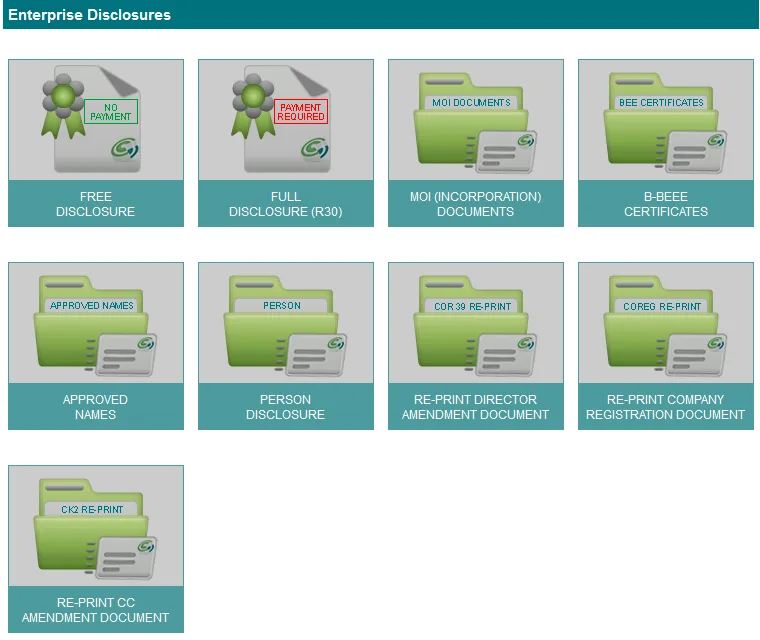
| Company documents | Registration certificates, disclosure certificates and copies |
| Deregistration and reinstatement | Closing a company, or restoring one that was deregistered |
| Intellectual property | Trade marks, patents, designs and copyright in film |
| B-BBEE certificates | Certificates for qualifying small businesses |
How to Register a Company With CIPC
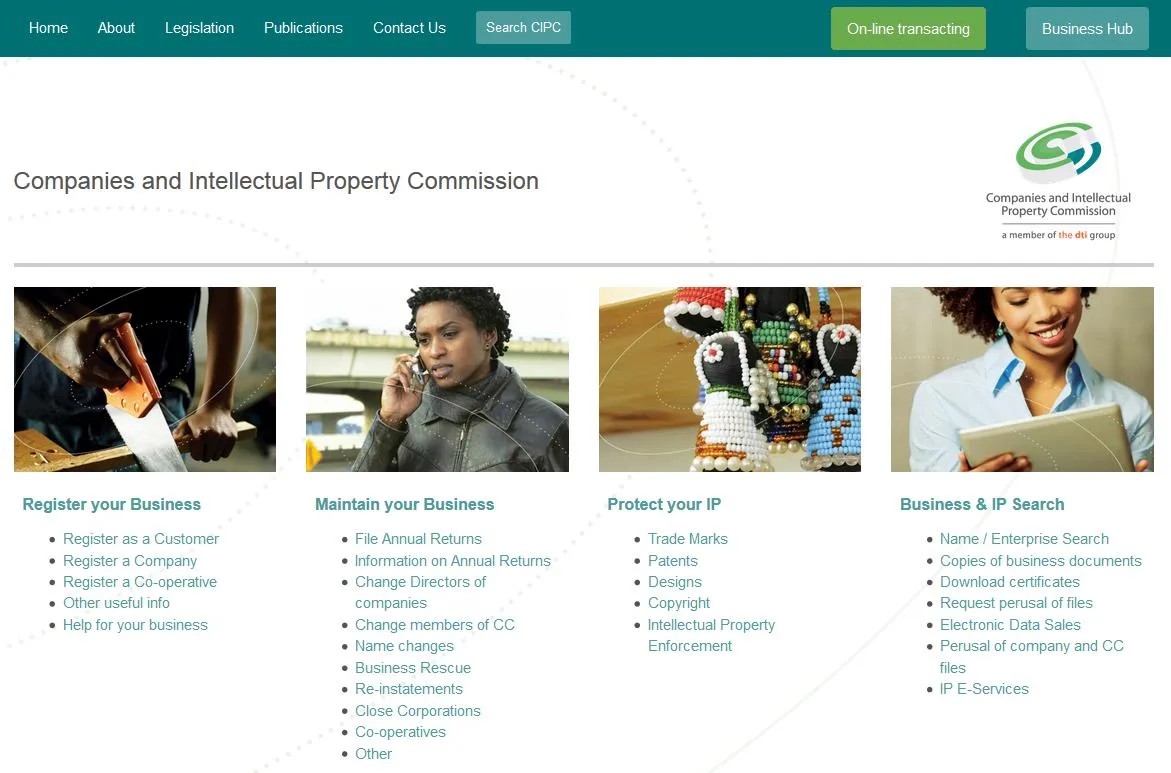
You register a company online, mainly through BizPortal, the government's business registration portal. You first need a CIPC customer profile. You then choose the company type, enter the directors' ID numbers (which are checked against Home Affairs), add contact details for each director, choose whether to register with a name, and pay.
A private company with a standard MOI is the most common choice for small businesses. CIPC says short-form registrations submitted through BizPortal, the mobile app, a bank or a self-service kiosk are processed immediately once payment is received, while customised MOI registrations take longer.
For the full walk-through, read our CIPC company registration guide. For the documents and details to prepare first, see CIPC company registration requirements.
How to Access CIPC Online Services
CIPC runs several online portals. The two most people use are:
- BizPortal (bizportal.gov.za): company registration, annual returns, director changes and other common filings. South African citizens log in with their ID number and CIPC password.
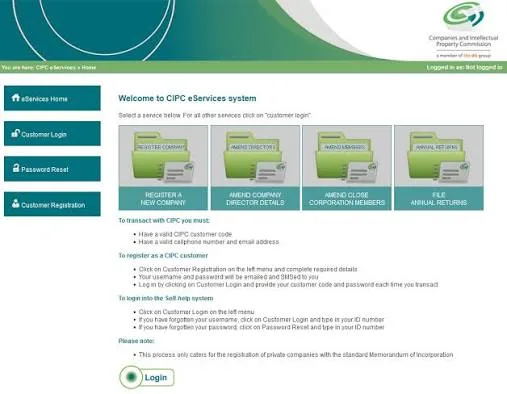
- CIPC e-Services (eservices.cipc.co.za): the original CIPC portal, used with a customer code and password. Foreign nationals without a South African ID use their customer code.
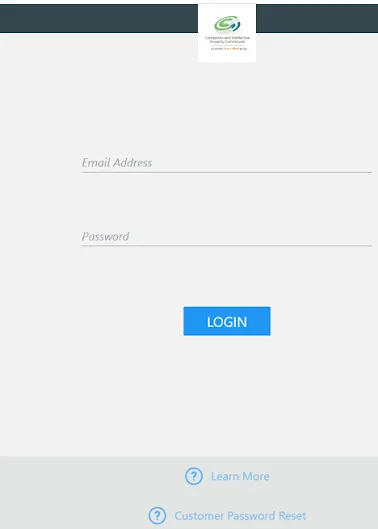
CIPC also runs separate portals for intellectual property, enquiries and annual financial statements. Our CIPC login guide explains which portal to use and how to sign in. If you are locked out, see CIPC password reset.
Only use addresses that end in cipc.co.za or bizportal.gov.za. CIPC services are not offered through social media messages or third-party "login" pages.
How to Search for a Company on CIPC
CIPC's registry can be searched online through BizPortal and CIPC e-Services. A search lets you confirm that a company exists, find its registration number and see its current status. More detailed records, such as a full disclosure certificate showing directors and history, cost a small fee (R30 for an electronic disclosure certificate on CIPC's published fee table).
See CIPC company search by name for how to search, and CIPC company status check for what statuses such as "In Business" or "Deregistered" mean.
How to File CIPC Annual Returns
Every company and close corporation must file an annual return with CIPC each year, even if it did not trade. The annual return confirms that the business still exists and updates its basic details. Companies file within 30 business days after the anniversary of their registration date. Filing is electronic only, through BizPortal, e-Services or a self-service centre.
Since 1 July 2024, a company's beneficial ownership declaration and securities register must be up to date before the annual return can be finalised. The fee depends on annual turnover, and late filing costs more.
Read CIPC annual return for the filing steps and CIPC annual return fees for the amounts.
What Is CIPC Beneficial Ownership?
A beneficial owner is a real person who ultimately owns or controls a company, directly or through other entities. CIPC's April 2026 FAQs use a threshold of 5% or more of shares, voting rights or similar interests. Companies and close corporations must file their beneficial ownership information with CIPC, update it within 10 business days of a change, and confirm it each year with the annual return. Co-operatives are excluded.
Beneficial owners are not always the same people as the directors or shareholders on record. Our beneficial ownership guide explains who counts and how to file.
How to Manage or Update Company Details on CIPC
After registration, changes to a company must be filed with CIPC. The most common are:
- Directors: appointing, removing or updating directors. Since 16 October 2026, CIPC has been rolling out a process in which a majority of existing directors must confirm a new appointment by one-time PIN (OTP). See CIPC change directors.
- Shareholders: share transfers are recorded in the company's own securities register, which is now filed with CIPC. See how to change shareholders on CIPC.
- Company name, MOI and share capital: changed by amending the MOI (form CoR15.2).
- Registered address: changed with form CoR21.1, effective at least 5 business days after filing.
- Closing or restoring a company: see how to deregister a company on CIPC and how to reinstate a company on CIPC.
What Are CIPC Fees and Charges?
CIPC charges a prescribed fee for most filings. The amounts below are from CIPC's published fee table, which carries no update date, so confirm them on cipc.co.za before you pay.
| Service | Fee |
|---|---|
| Name reservation (online) | R50 |
| Private company registration with a standard MOI | R175 (the R50 name fee is credited) |
| Company with a customised MOI | R475 |
| Director changes (CoR39) | Free |
| MOI amendment, including a name change | R250 |
| Voluntary deregistration (CoR40.1) | R250 |
| Reinstatement (CoR40.5) | R200, plus outstanding annual returns |
| Electronic disclosure certificate | R30 |
| Annual return | From R100, based on turnover |
Fees are paid from your prepaid CIPC customer account or by card for certain services. Our guides to the CIPC registration fee, annual return fees and CIPC banking details go into more detail.
What Happens If a Company Does Not Comply With CIPC?
The consequences build up over time:
- Late annual returns attract a higher fee than on-time returns.
- Missing beneficial ownership information blocks the annual return from being finalised, which leads to the same late fees.
- Repeated failure to file can lead CIPC to start deregistration. Under section 82(3) of the Companies Act, CIPC can deregister a company that has not filed annual returns for two or more years in a row. The company is notified first, and a company in this process shows a status such as "AR Deregistration Process".
- False information is an offence. CIPC can refer serious cases, such as false beneficial ownership declarations, for criminal investigation.
A deregistered company loses its legal existence. In some cases it can be restored through reinstatement, but this is not guaranteed and outstanding filings must then be brought up to date.
How to Contact CIPC in South Africa
These are the official channels listed on CIPC's contact page:
| Channel | Details |
|---|---|
| Online enquiries (CEMS) | enquiries.cipc.co.za. All enquiries must go through this system since 1 April 2026. |
| Call centre | 086 100 2472 (international: +27 87 743 7000) |
| Head office | the dtic Campus, Block F (Entfutfukweni), 77 Meintjies Street, Sunnyside, Pretoria |
| Office hours | Monday to Friday, 08:00 to 15:30 |
In November 2026, CIPC posted Notice 60 of 2026 saying the call centre was temporarily unavailable because of technical problems, and asked customers to log tickets on CEMS instead. Check CIPC's notices for the current position.
For how the enquiry system works, see CIPC enquiries. For walk-in service centres, see CIPC offices near me.
Common CIPC Problems and Their Solutions
| Problem | Likely cause | What to do |
|---|---|---|
| Cannot log in | Wrong portal, expired password or outdated contact details | Follow our CIPC password reset guide |
| Payment not showing | EFT from a bank other than ABSA, or wrong reference | Allow 2 to 3 working days. Check that you used your customer code as the reference (see CIPC banking details). |
| Annual return will not submit | Beneficial ownership not filed or out of date | File BO first (see our beneficial ownership guide) |
| Company shows as deregistered | Annual returns not filed for two or more years | See how to reinstate a company on CIPC |
| Director appointment cancelled | Existing directors did not confirm the OTP in time | Resubmit and make sure the directors confirm (see CIPC change directors) |
| Foreign director cannot be added | Foreign national not yet verified | Complete CIPC Foreigner Assurance |
Conclusion
CIPC is where a South African company's legal life begins and ends: registration, yearly annual returns, ownership and director records, and eventually deregistration. Most of it now happens online, so the practical first step is a working CIPC customer profile. From there, use the guides linked above for the task you need to complete, and check CIPC's own notices when a rule or fee matters.
Frequently Asked Questions
What does CIPC stand for?
CIPC stands for the Companies and Intellectual Property Commission. It is the South African agency that registers companies, co-operatives and intellectual property.
Is CIPC a government department?
CIPC is a government agency that falls under the Department of Trade, Industry and Competition. It was established by the Companies Act 71 of 2008.
Do I need to register my business with CIPC?
You need CIPC if you want a company, such as a private company (Pty) Ltd. A sole proprietor trading in their own name does not register a company with CIPC, although they still have tax obligations with SARS.
Does CIPC register trade marks?
Yes. CIPC registers trade marks, patents and designs, and copyright in cinematograph films, through its intellectual property e-services.
Is CIPC the same as SARS?
No. CIPC registers and regulates companies. SARS handles tax. A new company registered through BizPortal is normally registered for income tax with SARS as part of the same process, but tax matters stay with SARS.
How do I know if a CIPC website is real?
Official CIPC addresses end in cipc.co.za, and BizPortal uses bizportal.gov.za. Never enter your ID number, password or OTP on any other site.