
Name Reservation Checker
Check when a name reservation expires — valid for six months.
An approved reservation is valid for six months from approval, per CIPC's published name guidance. You may list up to four proposed names in one application. Confirm on the official CIPC website.
Banks, SARS, landlords and tender offices regularly ask for "your CIPC documents". That phrase can mean several different papers. This guide explains each one, what it proves, and where to get it.
Quick answer: The main CIPC documents are the registration certificate (CoR14.3), the notice of incorporation (CoR14.1), the Memorandum of Incorporation (MOI), the disclosure certificate and the annual return filing certificate. Download registration documents from CIPC e-Services or BizPortal. A full electronic disclosure certificate costs R30. CIPC does not issue share certificates. The company issues those itself.
The Main CIPC Documents at a Glance
| Document | What it shows | Where to get it | CIPC fee |
|---|---|---|---|
| Registration certificate (CoR14.3) | That the company is registered, its name, number and date | Download after registration | Free for 30 days, then R30 |
| Notice of incorporation (CoR14.1) and annexures | The details filed at registration, such as directors and address | Download after registration | Free for 30 days, then R30 |
| Memorandum of Incorporation (MOI) | The company's founding rules | Download after registration | Free for 30 days, then R30 |
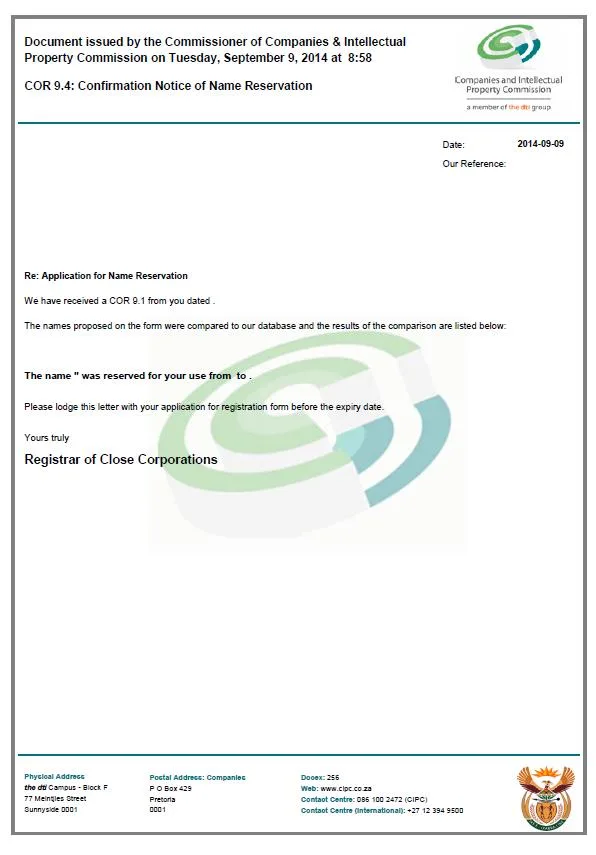
| Name reservation certificate (CoR9.4) | That a name is reserved for you | Download after approval | Free for 30 days, then R30 |
| Disclosure certificate | Current directors, address, status and history | Order online | R30 (electronic) |
| Annual return filing certificate | That a year's annual return was filed | Emailed after filing, reprint on e-Services | No separate fee |
| Director amendment confirmation (CoR39) | The updated list of directors | Emailed to active directors | Free |
| BO confirmation certificate | That beneficial ownership is filed (non-affected companies with BOs) | e-Services | Not stated |
| B-BBEE certificate | B-BBEE status for qualifying small businesses | e-Services, BizPortal or self-service terminal | Free, valid 12 months |
The 30-day free download period and the R30 fee after it come from CIPC's FAQs.
Registration Certificate (CoR14.3)
This is what most people mean by "the CIPC certificate". It confirms the company exists and shows its registered name, registration number and date of incorporation. You receive it when the company is registered (see CIPC company registration).
Older close corporations have "CK" documents instead, such as the CK1 founding statement. These are still valid records for existing CCs.
Disclosure Certificate
A disclosure certificate is an up-to-date extract of a company's record from CIPC's register, including its directors, registered address, status and history. Banks often ask for one when you open an account, because it shows the current directors rather than the ones at registration.
CIPC's notice on disclosure certificates says:
- A full electronic disclosure costs R30.
- Under section 6(7) of the Companies Act, an unaltered electronic reproduction can be used instead of an original.
- Accountable institutions, such as banks, can rely on it to confirm company and close corporation information.
Anyone can order a disclosure certificate for a company, which is also how you check another business's directors (see CIPC company search by name).
Annual Return Certificate
After you file an annual return, CIPC emails a filing certificate to the email linked to your customer code. To get it again, log in to e-Services and use Re-Print AR Certificates on the home menu. See CIPC annual return.
Does CIPC Issue Share Certificates?
No. Share certificates are issued by the company itself, signed by its authorised people, and recorded in the company's own securities register. CIPC does not print or store share certificates.
That is why searches for a "CIPC share certificate template" lead nowhere official. CIPC does publish guidance and a securities register template, because the securities register is now filed with CIPC alongside the beneficial ownership declaration (see beneficial ownership). For transfers, see how to change shareholders on CIPC.
How to Download Your CIPC Documents
- Log in to CIPC e-Services or BizPortal (see CIPC login).
- Find the company or the completed application, for example under your historical applications.
- Download the documents you need as PDFs.
- Save them somewhere safe. After 30 days, re-downloading costs R30.
How to Request Older or Missing Documents
If a document is not available to download, request it through CIPC's enquiry system, CEMS. CIPC has published a step-by-step guide for requesting documents via CEMS. Since 1 April 2026, paper and electronic disclosure requests go through CEMS (see CIPC enquiries).
Other CIPC fees for records, from its published fee table:
| Service (company) | Fee |
|---|---|
| Certificate relating to company information | R50 |
| Certified copy of a document on file | R20 |
| Personal inspection of a file | R100 |
Protect Your Company Documents
CIPC documents contain directors' names and partial ID numbers. Share them only with organisations that need them, and be wary of anyone who asks you to upload them to a site that is not cipc.co.za or bizportal.gov.za.
Frequently Asked Questions
What is a CoR14.3?
It is the company registration certificate CIPC issues when a company is incorporated.
How do I get a copy of my CIPC certificate?
Download it from e-Services or BizPortal. Within 30 days of registration it is free, then R30.
What is the difference between a registration certificate and a disclosure certificate?
The registration certificate shows the company at registration. A disclosure certificate shows its current details, including today's directors.
Can I get a share certificate from CIPC?
No. The company issues its own share certificates.
Is a printed electronic CIPC document valid?
CIPC says an unaltered electronic reproduction of a disclosure certificate can be used in place of an original.